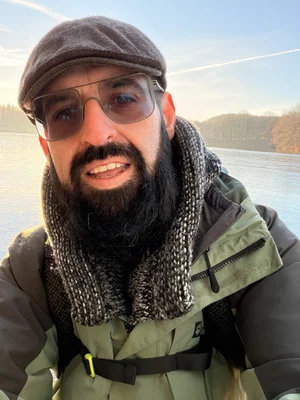
The night I let go, and why it's the best FinOps decision I ever made
Hey, you. Thanks for being here. What follows is a story that sits close to me. It might give you a glimpse of what drives me — and of how it connects to the world I work in every day: FinOps.
Let me take you back to August 2024. A few months earlier I'd made a decision I hoped would change my life for good. For years I'd fought a yo-yo battle with my weight — heavy enough that, at times, I had no mental room left for anything other than the digits after the decimal point on the scale. And I have a family that deserves my time. On 8 August 2024 I went in for surgery to rewire some of my internal plumbing: a gastric bypass. It was meant to give me room again, and to help me get my life — weight-wise — onto a v2. And, more importantly, keep it there.
It's now July 2026, almost two years on, and control is finally where I wanted it. The result: minus 40 kilos. And that v2 is what I want to talk to you about.
Two years ago I quietly booted up a new operating model for myself. Every year, I want to challenge myself — physically, but mentally just as much. Two years back, less than a year after surgery, I set myself a 658 km gravel ride: eight days around Lake Vänern in Sweden. This year I thought: I can do better. So I signed up for the longest bike race in the world (24 hours). The Vätternrundan sounds Swedish because Sweden, once again, plays the lead. This time, 315 km around Lake Vättern. And "around" is meant literally: roll out at 20:02 in the evening, ride through the night, and come back some 14 hours later. That was the plan, at least. And this is where I want to make the jump to the business world.
The plan. The journey toward the goal. The goal itself sits far away. Not something I'll knock out after dinner. It has to be a seriously big goal — something you genuinely have to work toward. Something that, at the start line at 20:02, doesn't yet feel achievable. Nothing about it obvious. And that's exactly where I see clients standing today with their cloud journey — never mind their cost control. It's a mountain. Hard to take in. A long road they can't really cover alone.
Here's the first thing to understand: a race like this isn't decided at the euphoric start, where everyone's fresh and feels invincible. It isn't decided at the finish, where the photos get taken either. It's decided in the night. In that stretch where nobody's standing on the roadside, where nobody's clapping, where it's just you and your plan. In FinOps we call that the operate phase: the less glamorous, seemingly endless part where governance actually comes alive, where teams have to change behaviour, where the win isn't in one report but in what you sustain week after week. That's where value is made or lost.
Somewhere deep in that night, two riders came past me. Not dramatically fast — just a touch quicker than I was going. And I felt it: I can latch onto this. Heart rate 128, speed 27 km/h. Perfect. I slid into the wheel and sat there comfortably. They asked me to rotate, to share some of the work up front. No problem. I took my turns on the front — heart rate 145 — then dropped back into the wheel to recover, and a few minutes later went again. We ground out a good 20 km like that. Turn over turn.
Until my data started telling me something else. You, my friend, aren't recovering the way you were. At that point you have two options. One: fold yourself in half and empty the tank to hold the wheel. Two: let go, and find recovery again. I chose the second. My two companions rode off into the night together. I saw them again at a feed stop — arrived maybe five minutes ahead of me, but wrecked. Me, still fresh.
And don't misread that: letting go was the hardest thing in that moment. Not for my legs — for my head. Everything in me was screaming to hold the wheel, to not give in, to sit there proud. That was the real exercise. Not the legs, but the mind. The muscle I trained hardest that night wasn't in my quads.
Because that's the difference between not seeing your data and seeing it. On feeling, I'd have burned myself out to stay in that wheel, proud, right up until I stalled in the dark. On data, I chose to let go, recover, and stay whole. In the dark, your gut is a bad guide — your numbers aren't. And that's the core of everything I do: you cannot control what you cannot see. A cloud bill is a single number. Only when you can see where that number comes from can you ride it, instead of buckling under it. Optimise as you go — and then make it your own. That, to me, is FinOps.
And no, a night race like that isn't a solo act, however it looks in the photos. Behind every "solo" effort there's a crew: someone who prepped the bike, feed stops that appeared at exactly the right moment, people who knew what I needed before I did. FinOps is no one-man show either. It only works when engineering, finance and the business are on the same road. The job isn't to ride the race for you — it's to have ridden it before. To know where the feed stops are, and to hold you at the right tempo when your gut is screaming at you to either surge or quit.
And then, somewhere after the night, the light breaks. The finish that felt impossible at 20:02 is suddenly behind you. The plan was around 14 hours. It came in at 12:42 moving time, 13:40 total. No heroics, no stalling in the dark — just a plan that landed inside its margins. And that's exactly the point.
Because here's the twist — and it's the exact same twist as my minus 40 kilos. The finish was never the goal. The goal was the v2. The operating model. The sustaining. A gastric bypass doesn't lock your weight in place; it gives you the room to choose it again, every single day. The Vätternrundan doesn't make me an ultra rider; it proves that an impossible goal becomes reachable with a plan, guidance, and sight of your numbers.
And FinOps? It's not a project with an end date. It's a practice. There's no finish line where you step off the bike and declare your cloud costs "done." Just look at what's already coming. The FinOps Foundation just stood up a Tokenomics discipline — the cost story around AI and tokens, still largely uncharted ground. And yet I see it at nearly every client: there's an appetite to fix this.
Here's the funny part. For years we worked ourselves up on cloud cost — from crawl to walk, for some even to run. And then Tokenomics comes along and puts us all back on our hands and knees. Welcome back to crawl — or honestly, pre-crawl, because most of us don't even know which way to start crawling yet. And still, this doesn't feel like a step back to me. It feels like a natural alliance, because we've done this before. Remember? Six years ago, when we all had to try taming cloud costs for the very first time. That exact story is ready for a do-over. A new goal. A new mountain to ride around. And you never start a race like that at full speed anyway. You roll out at 20:02 easy, you build, you find your rhythm. Crawl, walk, run — and only then, into the night.
So you keep riding. Just with this difference: once you can see what you're spending, where it's going, and why — you're no longer riding in the dark. You're the one steering.
That's what an ultra race taught me about FinOps. You cannot control what you cannot see — but the moment you can see, you can go anywhere.
Until next time. And who knows — maybe out there somewhere, on some path, with a mountain ahead of us.